

Wondering if you can truly find a great-fitting suit without leaving your house? Taking your own measurements is the essential first step to buying a suit online with confidence. This guide provides simple, clear instructions to ensure you get it right the first time, helping you avoid the hassle of returns and achieve a sharp, tailored look.
To accurately measure yourself for a suit, you will need a soft measuring tape and a friend to assist, though it is possible to do it alone. Focus on key areas: for the jacket, measure your chest, shoulders, sleeves, and waist. For the trousers, measure your waist, hips, and inseam. Always stand naturally and don’t pull the tape too tight. Comparing these numbers to a brand’s size chart is the final step to finding your perfect fit.
What You’ll Need to Measure for a Suit at Home
Before you begin, gathering a few simple tools will make the process smooth and accurate. The most critical item is a soft, flexible measuring tape, the kind used for sewing. A rigid metal tape measure from a toolbox will not wrap around your body correctly and will lead to inaccurate numbers. If you don’t have one, they are widely available at craft stores or online.
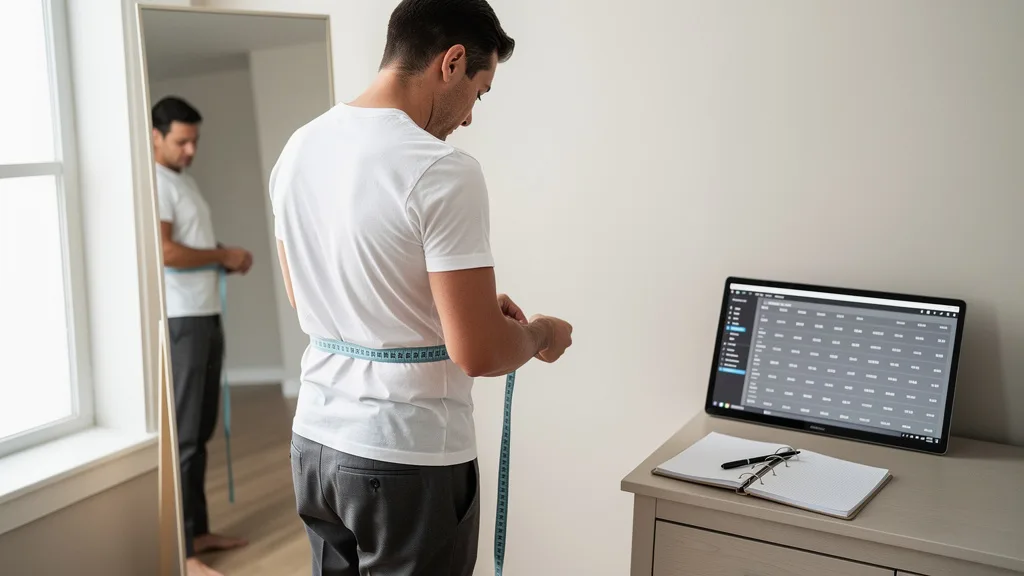
It’s also highly recommended to have a friend help you, especially for measurements like shoulder width and sleeve length, which are difficult to take accurately on your own. Wear form-fitting clothing, like a t-shirt and briefs, to avoid adding extra inches from bulky garments. Finally, have a pen and paper or a notes app on your phone ready to record each measurement as you take it. This prevents confusion and ensures you have a reliable record to reference when looking at a suit size chart.
How to Measure for a Suit Jacket: A Step-by-Step Guide
The suit jacket is the centerpiece of your ensemble, and its fit determines the entire silhouette. Learning how to measure yourself for a suit at home in 5 easy steps starts with the jacket. These five core measurements will give you the data needed to select a jacket size that looks custom-made. Remember to stand in a relaxed, natural posture throughout the process.

Don’t suck in your stomach or puff out your chest, as this will distort the measurements. The goal is to measure your body as it is, ensuring the suit you purchase allows for comfortable movement. Follow these steps carefully, recording each number before moving to the next. This methodical approach is key to success when buying a men’s suit online.
1. Chest Measurement
To measure your chest, stand up straight and wrap the measuring tape around the fullest part of your chest. This is typically just under your armpits and across your shoulder blades. The tape should be snug but not so tight that it constricts your breathing. Make sure the tape is level all the way around and parallel to the floor.
Once the tape is in position, take a normal breath and record the measurement. It’s a good practice to place one finger between the tape and your body to ensure a little extra room for comfort and movement. This single measurement is often the primary indicator of your jacket size, for example, a 40-inch chest measurement usually corresponds to a size 40 suit jacket.
2. Shoulder Width
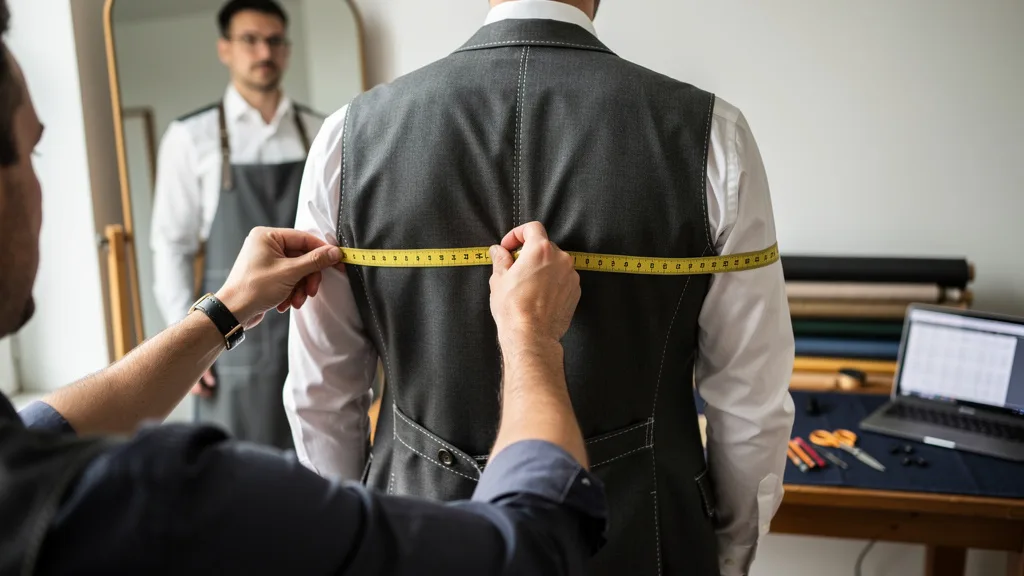
Measuring your shoulder width is one of the most challenging parts to do alone, so assistance is highly recommended. Stand with your shoulders relaxed. Your helper should place the start of the measuring tape at the point where your shoulder meets your arm on one side. This is the bony point right at the top of your arm.
Stretch the tape straight across your back to the same point on the opposite shoulder. The tape should follow the natural curve of your upper back. This measurement is crucial because the shoulder seams of your jacket should sit perfectly on your shoulder points. A jacket that is too wide in the shoulders will look sloppy, while one that is too narrow will feel restrictive.
3. Sleeve Length
For the sleeve length, let your arm hang naturally at your side with a slight bend at the elbow. Place the end of the measuring tape at the same shoulder point where you started the shoulder width measurement. Run the tape down the outside of your arm, over your elbow, and down to your wrist bone.
The ideal suit sleeve should end right at the wrist bone, allowing about a half-inch of your shirt cuff to show. Measuring with a slight bend in your arm is important because it mimics your natural arm position and ensures the sleeve isn’t too short when you move. For more information on precise measuring techniques, this guide on How to Measure Waist, Chest, and sleeves provides excellent visuals.
4. Jacket Waist (Stomach)
The jacket waist measurement is taken around the widest part of your stomach, which is usually right at the level of your navel. Wrap the tape measure around your torso at this point, keeping it level with the floor. As with the chest measurement, the tape should be snug but not tight.
This measurement helps determine the button stance and tapering of the jacket. A properly fitted jacket will gently hug your midsection, creating a defined waistline without pulling at the button. This is especially important for achieving a flattering look in both a modern fit and a slim fit suit, as it helps create a V-shaped torso.
5. Jacket Length
To determine the correct jacket length, stand straight with your arms relaxed at your sides. The measurement starts at the base of the back of your neck, where the collar of a shirt would sit. Run the tape measure straight down your back.
The traditional rule is that the jacket should end around your mid to lower crotch, or where your fingertips end when your arms are hanging naturally. A more modern approach suggests the jacket should just cover the seat of your trousers. This measurement ensures the jacket properly balances your upper and lower body proportions.
How Should a Suit Jacket Fit? Key Checkpoints
Knowing your measurements is only half the battle; understanding what a good fit looks and feels like is just as important. The shoulders are the most critical area. The jacket’s shoulder seam should end precisely at your natural shoulder point. If it extends beyond, the jacket is too big. If it sits before your shoulder point, it’s too small.
The jacket collar should rest flat against your shirt collar at the back of your neck, without a significant gap. When the top button is fastened (on a two-button suit), the lapels should lie flat against your chest without bowing or creating an ‘X’ shape. This ‘X’ indicates the jacket is too tight across the waist. You should be able to comfortably slip a hand between your chest and the fastened jacket.
“A well-fitting suit starts with accurate measurements. Taking the time to do it right at home is the single most important step toward achieving a sharp, tailored look without the initial tailor visit.”
Finally, check the sleeve length. With your arms at your sides, about a quarter to a half-inch of your shirt cuff should be visible beyond the jacket sleeve. This small detail creates a clean, polished finish. Considering these checkpoints will help you evaluate whether a suit jacket provides the perfect fit you’re looking for.
How to Measure for Suit Trousers
Just as with the jacket, getting accurate measurements for your trousers is essential for a comfortable and stylish look. The process is straightforward and focuses on the waist, inseam, and hips. For these measurements, it’s best to use a pair of dress pants or chinos that already fit you well as a reference point, in addition to measuring your body.
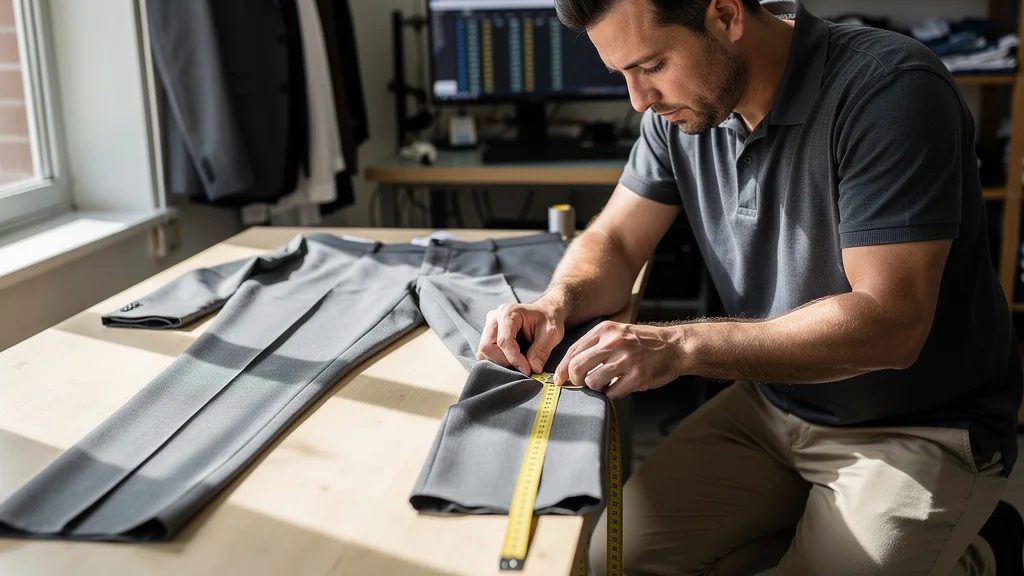
Lay the reference trousers flat on a table to measure them, as this is often easier than trying to measure yourself while wearing them. However, measuring your own body is still the most reliable method. Ensure you are standing straight and relaxed for the best results. These simple steps will help you find trousers that fit perfectly from the waist down to the ankle.
1. Trouser Waist
To measure your trouser waist, locate your natural waistline. This is the narrowest part of your torso, typically an inch or two above your belly button. Wrap the measuring tape around your natural waist, keeping it level. The tape should be snug, but you should be able to fit one finger behind it for comfort.
Do not rely on the size of your jeans, as denim sizing can be inconsistent and often incorporates vanity sizing. Your true waist measurement is the most reliable number for finding dress trousers. This measurement ensures your trousers will sit comfortably without a belt, which is the mark of a great fit.
2. Inseam (Inside Leg)
The inseam measurement determines the length of your trousers from the crotch to the hem. This is another measurement where a friend’s help is invaluable. Stand with your feet about shoulder-width apart. Have your helper measure from the very top of your inner thigh (at the crotch) straight down to the point where you want your trousers to end.
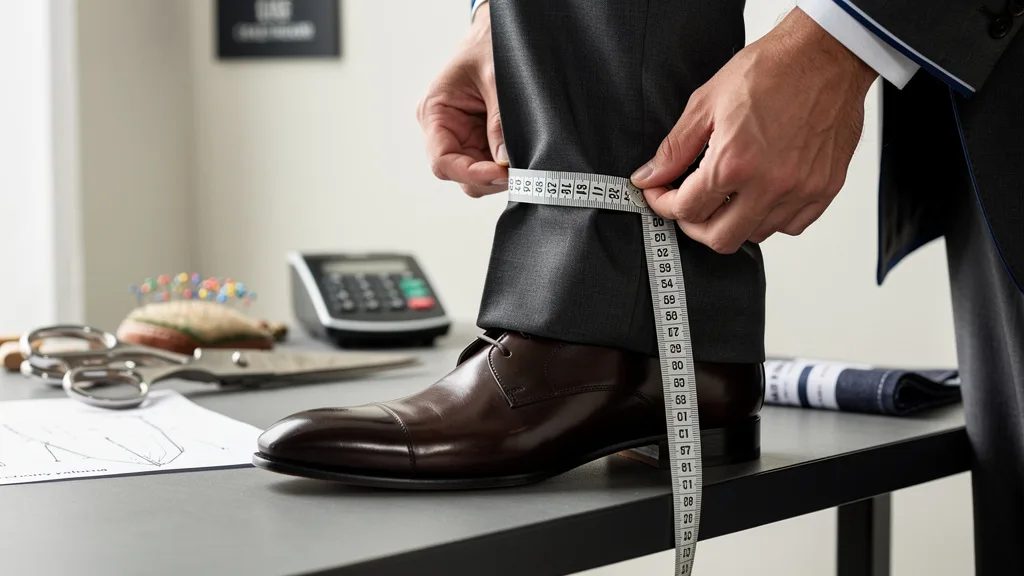
This end point depends on your preferred ‘break’, which is how much the trouser fabric folds over your shoe. For a modern, no-break look, measure to the top of your shoe. For a slight or half-break, measure to about mid-way down the back of your shoe. Alternatively, you can measure the inseam of a pair of well-fitting pants by laying them flat and measuring from the crotch seam to the bottom of the leg.
3. Hips and Seat
The hip or seat measurement ensures you have enough room for comfortable movement without the fabric pulling or feeling too baggy. To measure your hips, stand with your feet together. Wrap the measuring tape around the fullest part of your hips and buttocks.
Make sure the tape is parallel to the floor and snug but not tight. You should be able to move and sit comfortably in your trousers. This measurement is particularly important for athletic builds or anyone who finds that trousers are often tight in the seat area.
4. Outseam (Total Length)
The outseam measures the total length of the trousers from the top of the waistband down to the hem. To take this measurement, stand straight and have a friend measure from the top of your waistband on your side, down the outside of your leg, to where you want the trousers to end.
This measurement serves as a good cross-reference with your inseam and rise (the distance from the crotch to the waistband). While the inseam is more commonly used by retailers, knowing your outseam can be helpful when dealing with made-to-measure services or comparing different trouser styles, like those found in a two-piece suit.
What Is the Perfect Fit for Suit Trousers?
The perfect fit for suit trousers balances comfort and a clean, tailored aesthetic. The trousers should sit comfortably on your natural waist without needing a belt to hold them up. If you need to cinch a belt tightly, the waist is too large. Conversely, if the waistband digs into your skin, it’s too small.
Through the seat and thigh, the trousers should skim your body without pulling or appearing baggy. You should be able to pinch about an inch of fabric on either side of your thigh. When you sit down, the trousers should not feel restrictive. The ‘break’ is the final checkpoint. A full break means a significant fold of fabric at the ankle, a half-break is a slight fold, and no break means the hem just skims the top of your shoe. The choice of break is a matter of personal style, but a slight or half-break is a timeless and versatile option.
Common Measurement Mistakes and How to Avoid Them
One of the most frequent errors is pulling the measuring tape too tight. Your measurements should be snug but not constricting, as this will result in a suit that is too small. Always ensure you can slip a finger between the tape and your body. Another common mistake is measuring over bulky clothing. This can add inches to your measurements, so always measure in light, form-fitting clothes.
Sucking in your stomach or flexing your muscles will also lead to inaccurate numbers. Stand in a relaxed, natural posture for every measurement. Finally, not keeping the tape measure level is a major pitfall. Whether measuring your chest, waist, or hips, ensure the tape is parallel to the floor all the way around your body. Taking your time and double-checking each number can prevent these common mistakes and save you from a poor-fitting suit. This detailed guide on How to Measure Yourself for a suit offers more tips on avoiding errors.
| Fit Issue | Visual Cue | Potential Solution |
|---|---|---|
| Jacket Too Tight | ‘X’ crease at the button | Size up in the chest or choose a different fit (e.g., modern instead of slim) |
| Shoulders Too Wide | Shoulder seam hangs off the shoulder point | Size down or choose a brand known for narrower shoulders |
| Sleeves Too Long | No shirt cuff is visible | A tailor can easily shorten sleeves |
| Trousers Too Baggy | Excess fabric in the seat and thighs | Size down in the waist or have a tailor taper the legs |
How to Use Your Measurements with a Suit Size Chart
Once you have your list of accurate measurements, you are ready to use a brand’s size chart. These charts are crucial because sizing can vary significantly between different manufacturers. A size 42R from one brand might fit differently than a 42R from another. Always refer to the specific chart for the suit you are interested in.
Your chest measurement is the primary number for determining your jacket size. For example, a 40-inch chest will typically correspond to a size 40 jacket. Your trouser size is determined by your waist measurement. Most brands will list the corresponding chest, shoulder, and sleeve lengths for each jacket size. Compare all your measurements to the chart to find the best overall match. If you fall between sizes, it’s generally better to size up, as it’s much easier for a tailor to take a suit in than to let it out. A casual suit may have a more relaxed fit, so always check the specific product’s chart.
Key Takeaways
Successfully measuring yourself for a suit at home is achievable with the right tools and techniques. This skill empowers you to shop online confidently and find garments that fit well from the start. Remember that accuracy is paramount, so take your time and double-check your numbers.
- Use the Right Tools: A soft, flexible measuring tape is non-negotiable for accurate results.
- Measure the Key Points: For a jacket, focus on the chest, shoulders, and sleeve length. For trousers, the waist and inseam are most important.
- Understand a Good Fit: Know what a well-fitting suit looks like. The shoulders should be sharp, the waist defined, and the trouser break clean.
- Consult the Size Chart: Always compare your measurements to the specific brand’s size chart, as sizing is not universal.
- When in Doubt, Size Up: It’s easier and cheaper for a tailor to make a suit smaller than it is to make it larger.
Frequently Asked Questions
What is the 5-suit rule for men?
The ‘5-suit rule’ is a guideline suggesting a man should own five essential suits to be prepared for any occasion. This typically includes a navy suit and a charcoal or gray suit for business and versatile wear, a black suit for formal events like funerals or black-tie optional functions, a lighter-colored suit (like light gray or tan) for summer or daytime events, and a patterned or statement suit (like pinstripe or plaid) to express personal style.
This ‘rule’ is more of a traditional framework for building a complete and versatile wardrobe. It ensures you have appropriate attire for professional, social, and formal settings without having to scramble for a last-minute outfit. For many, a versatile tuxedo dinner suit can also be a key part of this collection.
How do I convert my measurements to a standard suit size?
Your suit jacket size is primarily determined by your chest measurement. If your chest measures 40 inches around its fullest part, you will typically wear a size 40 jacket. The letter that follows the number (S, R, or L) refers to the jacket’s length and is based on your height. As a general rule, ‘S’ (Short) is for men 5’7″ and under, ‘R’ (Regular) is for men 5’8″ to 6’0″, and ‘L’ (Long) is for men 6’1″ and taller.
For trousers, the size is simply your waist measurement in inches. So, if your waist measures 34 inches, you will look for size 34 trousers. Always check the brand’s specific size chart, as they will provide the most accurate conversion from your body measurements to their sizing convention.
Is a size 42 suit considered large?
A size 42 suit is generally considered a medium to large size in the United States, often falling into the ‘Large’ category for many brands. However, ‘large’ is relative. In the context of average male sizing, a 42R is a very common size and sits comfortably in the middle of the standard size run for most retailers, which can range from size 36 to size 50 or more.
The perception of whether it’s ‘large’ depends on an individual’s build and the average size of the population in a specific region. Ultimately, the number is less important than the fit. A size 42 suit that fits perfectly will look much better than a size 40 suit that is too tight.
Do these measurements work for both slim and modern fit suits?
Yes, these core body measurements work for any suit fit, whether it’s slim, modern, or classic. Your body measurements are a constant. The difference between a slim fit and a modern fit lies in how the suit is constructed based on those measurements. A slim fit suit will be cut closer to the body, with less excess fabric, narrower lapels, and a more tapered leg.
A modern or contemporary fit offers a compromise between slim and classic, with a tailored silhouette that isn’t as restrictive as a slim fit. When using a size chart, you’ll select your size based on your measurements, and then choose the ‘fit’ (slim, modern) that aligns with your style preference. The fit description will tell you how closely the garment will sit on your frame.
Will I still need a tailor after measuring myself at home?
It is very likely that you will still benefit from a visit to a tailor. Learning how to measure yourself for a suit at home is about getting the best possible off-the-rack fit, which minimizes the amount of alterations needed. It helps you choose the right base size, which is the most important and most expensive thing to get right.
However, off-the-rack suits are made for standard body types, and very few people are a perfect ‘standard’. A tailor can make small, inexpensive adjustments to sleeve length, trouser hem, and waist suppression that elevate a good fit to a perfect fit. Think of home measuring as getting you 90% of the way there, with a tailor providing the final 10% polish.
Conclusion
Mastering how to measure yourself for a suit at home demystifies the process of buying tailored clothing online. By following these clear steps for your jacket and trousers, you can confidently translate your unique proportions into a suit size that provides a strong foundation for a sharp silhouette. This guide for 2026 ensures you avoid common pitfalls and use size charts effectively, putting the power of a great fit directly into your hands.
Now that you’re equipped with your precise measurements, you’re ready to explore styles that match your taste. From timeless business suits to modern casual looks, finding the right piece is simpler than ever. Browse our curated collection to find your perfect suit today. SHOP NOW.